

Artificial intelligence (AI) is becoming an important part of modern technology. From smartphones and online services to business software and smart devices, AI is changing how technology works and how people interact with it.
The impact of AI is not limited to one industry. Businesses, schools, healthcare organizations, financial services, transportation companies, and everyday consumers are increasingly using AI-powered tools to complete tasks, analyze information, and solve problems.
Understanding the 7 Ways AI Is Changing the Future of Technology can help us see how artificial intelligence may influence the digital world in the coming years. AI is making technology more intelligent, automated, personalized, and capable of handling complex tasks.
The future of technology will likely involve greater cooperation between people and intelligent digital systems. Rather than replacing every existing technology, AI can make many technologies more useful and efficient.
7 Ways Artificial Intelligence Is Transforming Technology
AI is changing the future of technology through automation, personalization, smarter decision-making, advanced cybersecurity, improved software development, intelligent devices, and better digital experiences.
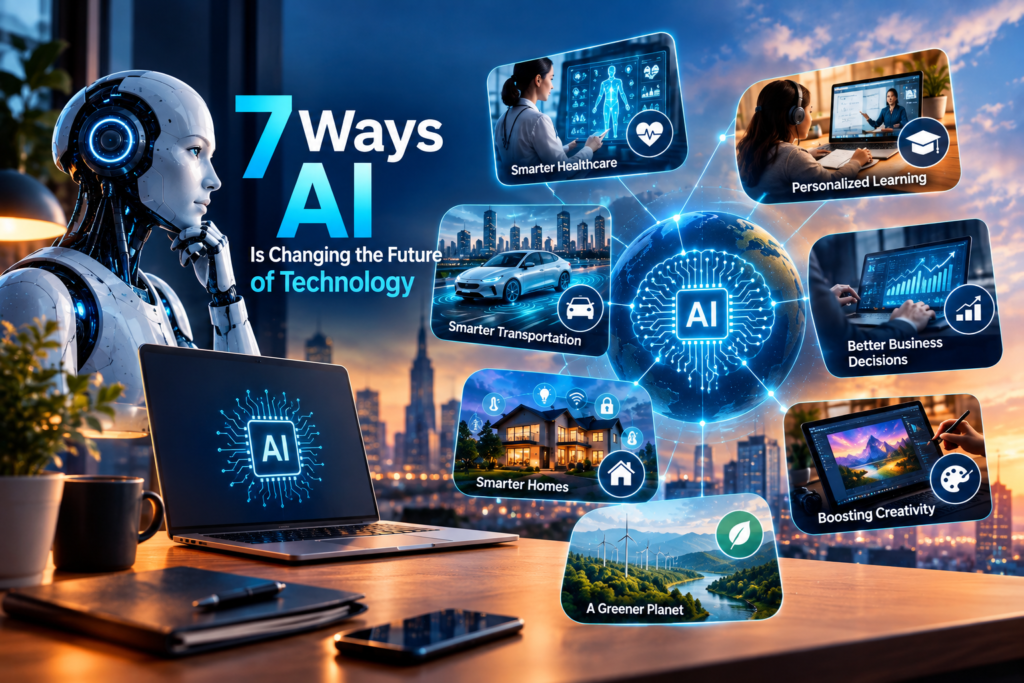
Let’s explore these seven major ways in detail.
1. AI Is Making Technology More Automated
One of the biggest ways AI is changing technology is through automation. Traditional software usually follows instructions created by developers. AI systems can analyze information, recognize patterns, and perform certain tasks with less direct human input.
Businesses can use AI to automate repetitive activities such as:
- Organizing information
- Sorting customer requests
- Generating basic reports
- Analyzing large datasets
- Scheduling tasks
- Processing routine documents
- Responding to common questions
Smarter Automation
AI-powered automation can go beyond simple repetitive actions. Modern AI systems can process different types of information and make decisions based on patterns in available data.
For businesses, this can reduce the amount of time employees spend on routine work. Employees can then focus more on creative, strategic, and customer-focused activities.
Automation is likely to remain an important part of the future because businesses are constantly looking for ways to improve efficiency.
2. AI Is Creating More Personalized Technology
Another important way AI is changing the future of technology is through personalization.
Many digital platforms already analyze user behavior to provide more relevant experiences. AI can process information about preferences, searches, interactions, and previous activities to help systems respond more effectively.
For example, AI can help digital platforms provide:
- Personalized recommendations
- Customized content
- Relevant search results
- Smart product suggestions
- Personalized learning experiences
- Adaptive digital interfaces
Personalized User Experiences
Instead of providing exactly the same experience to everyone, future technologies may become increasingly adaptive.
For example, an educational platform could adjust learning materials based on a student’s progress. Similarly, a shopping platform could provide product recommendations based on previous interactions.
This can make digital experiences more convenient and relevant.
3. AI Is Improving Decision-Making
AI can process large amounts of information much faster than humans can manually analyze it. This makes AI useful for identifying patterns and supporting decision-making.
Businesses can use AI to examine:
- Sales information
- Customer behavior
- Market trends
- Inventory data
- Website activity
- Operational performance
Data-Driven Business Decisions
AI does not necessarily replace human decision-making. Instead, it can provide information that helps people make more informed decisions.
For example, a business might use AI to identify which products are selling faster or which customer segments are showing increased interest.
Human judgment remains important because AI systems depend on the quality of the data they receive and the way their results are interpreted.
4. AI Is Changing Cybersecurity
As technology becomes more connected, cybersecurity is becoming increasingly important. AI can help organizations identify unusual patterns and potentially suspicious activities.
Traditional security systems may rely heavily on predefined rules. AI-based systems can analyze patterns of activity and identify behavior that differs from normal activity.
Faster Threat Detection
AI can potentially help security teams:
- Monitor large amounts of activity
- Identify unusual behavior
- Detect suspicious patterns
- Prioritize potential threats
- Automate certain security responses
- Analyze security data more efficiently
The use of AI in cybersecurity is expected to continue developing as both defensive and malicious technologies become more sophisticated.
Organizations still need strong security practices, including software updates, access controls, employee training, and secure passwords.
5. AI Is Transforming Software Development
Software development is another area where AI is creating significant changes.
AI-powered development tools can assist programmers with tasks such as generating code suggestions, explaining code, identifying potential errors, and creating documentation.
Faster Development Workflows
AI tools can help developers reduce time spent on some repetitive coding tasks.
For example, a developer may describe a function they need, and an AI tool can provide a possible implementation that the developer can review and modify.
However, AI-generated code still needs human review. Developers must check the code for accuracy, security, performance, and compatibility with the rest of the application.
The future of software development may therefore involve greater collaboration between developers and AI-powered tools.
6. AI Is Making Smart Devices More Intelligent
Smartphones, watches, home devices, vehicles, and other connected products are becoming more capable as AI is integrated into them.
AI can help devices understand information, recognize patterns, respond to users, and automate certain functions.
Examples of AI-Powered Devices
| Technology | Possible AI Application |
|---|---|
| Smartphones | Voice features and intelligent photo tools |
| Smartwatches | Activity and health-related insights |
| Smart Homes | Automated device control |
| Vehicles | Driver-assistance features |
| Cameras | Image recognition |
| Smart Assistants | Voice-based interactions |
As AI becomes more integrated into everyday devices, technology may require less manual interaction.
For example, instead of opening several settings and applications, users may increasingly communicate with devices through natural language.
7. AI Is Changing How People Interact With Technology
Perhaps one of the most visible changes is the way people interact with digital systems.
Traditional technology often requires users to understand menus, buttons, commands, and software interfaces. AI allows people to communicate with some systems using natural language.
Natural Language Interaction
Users can increasingly interact with technology by:
- Asking questions
- Giving voice commands
- Describing tasks
- Requesting summaries
- Asking for recommendations
- Providing instructions in everyday language
This can make technology easier to use, especially for people who are not highly familiar with complicated software.
The future may bring more conversational interfaces where users explain what they want rather than manually navigating through multiple menus.
Key Areas Where AI Is Changing Technology
The following table summarizes the 7 Ways AI Is Changing the Future of Technology:
| Area | How AI Is Changing It |
|---|---|
| Automation | Reduces repetitive manual work |
| Personalization | Creates more relevant digital experiences |
| Decision-Making | Helps analyze large amounts of information |
| Cybersecurity | Supports faster detection of unusual activity |
| Software Development | Assists with coding and development tasks |
| Smart Devices | Makes connected devices more intelligent |
| User Interaction | Enables more natural communication with technology |
Benefits of AI for the Future of Technology
AI can provide several potential benefits when it is developed and used responsibly.
Greater Efficiency
AI can automate certain repetitive tasks and process information quickly.
Better Personalization
Digital services can become more responsive to individual users.
Faster Information Processing
AI can help organizations analyze large amounts of data and identify patterns.
Improved Accessibility
Natural-language interfaces and AI-powered assistance may make certain technologies easier to use.
More Intelligent Products
AI can make software, devices, and services more adaptive and responsive.
Challenges of AI Technology
Although AI offers many opportunities, its development also creates challenges that businesses and technology users need to consider.
Data Privacy
AI systems may process large amounts of information. Organizations need appropriate privacy and security practices when handling user data.
Accuracy
AI systems can sometimes produce incorrect or misleading results. Important decisions should therefore include appropriate human review.
Bias
AI systems can reflect problems in the data used to train or operate them. Developers need to test systems carefully and monitor their results.
Job Changes
Automation may change the tasks people perform in some industries. This makes training and skill development increasingly important.
Security Risks
AI can be used for both defensive and harmful purposes. Organizations need to continuously improve their security practices as technology develops.
How Businesses Can Prepare for AI
Businesses do not necessarily need to adopt every new AI tool. A better approach is to identify areas where AI can solve genuine problems.
Businesses can start by:
- Identifying repetitive tasks.
- Reviewing where employees spend the most time.
- Testing appropriate AI tools.
- Training employees.
- Protecting sensitive information.
- Monitoring AI-generated results.
- Measuring whether the technology provides real value.
A gradual approach can help businesses understand the benefits and limitations of AI before making larger investments.
The Future of AI and Technology
The future of AI is likely to involve deeper integration with everyday technology. AI may become less visible as a separate tool and more commonly built into the software and devices people already use.
Instead of always opening a specific AI application, people may interact with AI features directly through smartphones, computers, websites, vehicles, business software, and smart home systems.
At the same time, responsible development will remain important. Privacy, security, transparency, accuracy, and human oversight will play an important role in determining how AI is used.
Frequently Asked Questions
What are the 7 Ways AI Is Changing the Future of Technology?
The seven major ways include automation, personalization, improved decision-making, cybersecurity, software development, smarter devices, and more natural human-computer interaction.
How is AI changing everyday technology?
AI is making everyday technology more intelligent by supporting features such as voice interaction, personalized recommendations, smart devices, image recognition, automation, and intelligent search.
Will AI replace traditional technology?
AI is more likely to become integrated into existing technologies rather than completely replace every form of traditional technology. Many products and services may use AI to become more capable and efficient.
Why is AI important for the future?
AI can help technology process information, automate tasks, recognize patterns, and provide more personalized experiences. These capabilities can influence many industries and everyday digital services.
How does AI help businesses?
AI can help businesses automate repetitive tasks, analyze data, improve customer experiences, support marketing, assist employees, and identify useful patterns in business information.
Is AI safe to use?
AI can be useful when used responsibly, but organizations need to consider privacy, security, accuracy, bias, and appropriate human oversight.
Conclusion
The 7 Ways AI Is Changing the Future of Technology show how artificial intelligence is becoming an important part of the digital world. AI is improving automation, personalization, decision-making, cybersecurity, software development, smart devices, and human-computer interaction.
The future of technology will likely involve closer cooperation between people and AI-powered systems. Businesses and individuals can benefit from these developments by learning how AI works, choosing useful tools, and using them responsibly.
AI is not simply changing one type of technology. It is influencing how many different technologies are designed, operated, and experienced. As AI continues to develop, its role in everyday digital life is likely to become even more significant.