
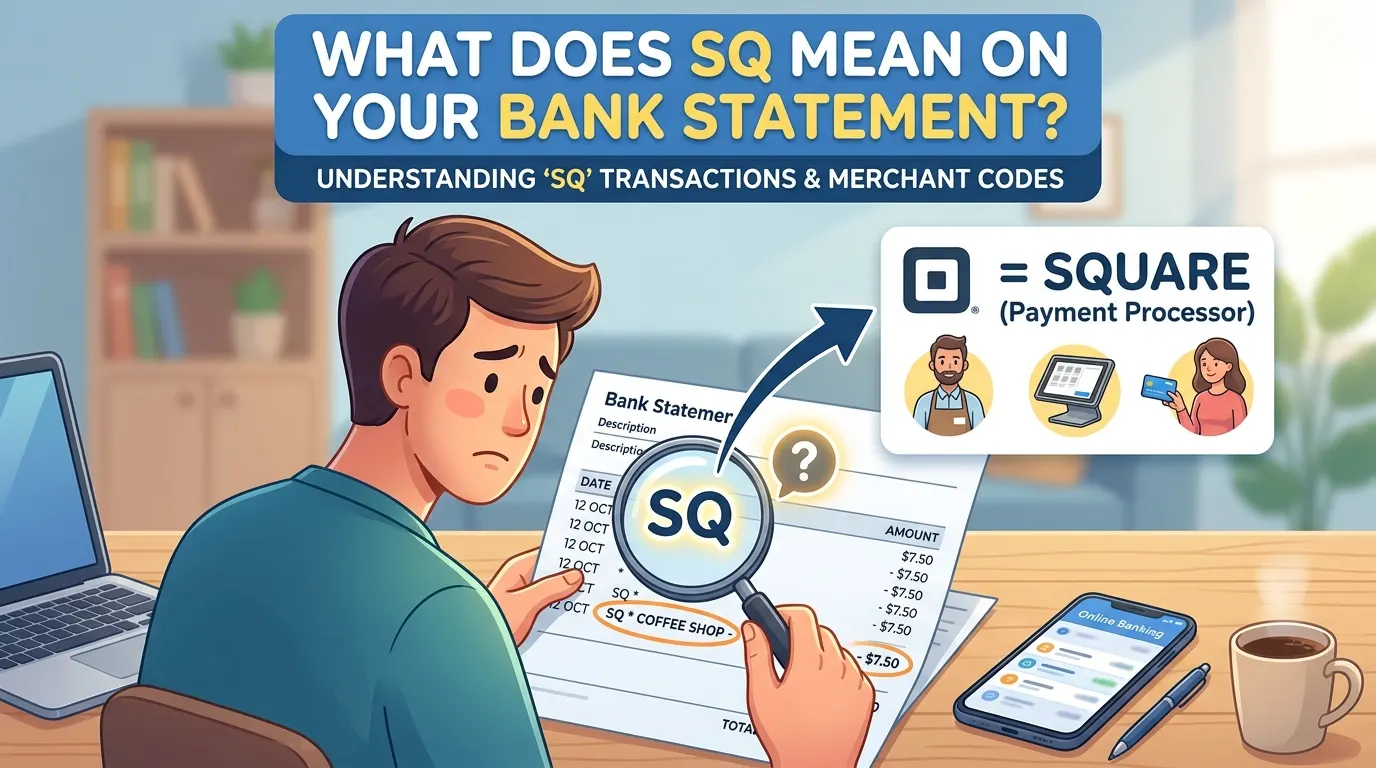

Regularly checking your bank or credit card statements can make you see a transaction with an SQ code and cause confusion. Many people find SQ worrisome at first, especially if they don’t recognize the merchant right away.
In most cases, SQ refers to a transaction completed with Square, a well-known processing company that helps businesses of all sizes process payments for their customers. Knowing what does SQ mean on bank statement will help you locate the purchase and avoid disputes or problems related to things you might not have known about SQ before!
In this article, we discuss what SQ means, how it shows up on a statement, how to figure out what you purchased using this code, and what to do if you can’t remember using the service.
What Does SQ Mean on Bank Statement?
SQ is a term used on credit or debit card statements for purchases made through the Square payment service. This service can help businesses of any size process card payments through point-of-sale terminals, card readers, online payment systems, and invoicing systems.
When you purchase something from a merchant that uses the Square service, you may receive a credit card statement with SQ followed by the name of the business from which you purchased the item.
For instance, you can see entries, such as:
- SQ Coffee House
- SQ Local Market
- SQ Online Store
These descriptions indicate that the payment was processed through Square rather than directly through the merchant’s own payment system.
Why Does SQ Appear on Your Bank Statement?
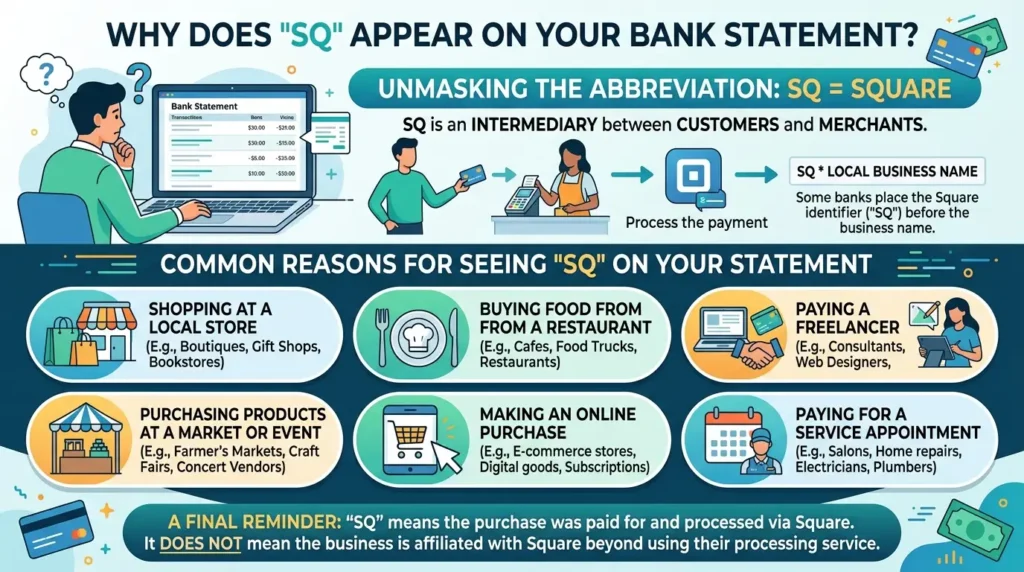
One of the most common reasons people search for what does SQ mean on bank statement is because they do not recognize the abbreviation.
Square is an intermediary between customers and merchants. So, instead of showing only the business name, some banks put the Square identifier first.
You can see SQ on your statement after:
- Shopping at a local store
- Buying food from a restaurant
- Paying a freelancer
- Purchasing products at a market or event
- Making an online purchase
- Paying for a service appointment
The appearance of SQ on your bank statement doesn’t mean the purchase was from a business affiliated with Square; it only means the purchase was paid for and processed via Square.
How Square Processes Payments
Understanding how Square works will help you understand SQ. In short, when you pay with your debit card, credit card, or mobile wallet, it’s processed securely through the merchant’s Square device and then sent to the banking system for approval.
After approval:
- The payment is charged to your card.
- The merchant receives the funds.
- The transaction appears on your bank statement.
- The statement description often includes SQ.
Because millions of businesses use Square, it is common to see SQ on a bank statement.
Examples of SQ Charges on Bank Statement
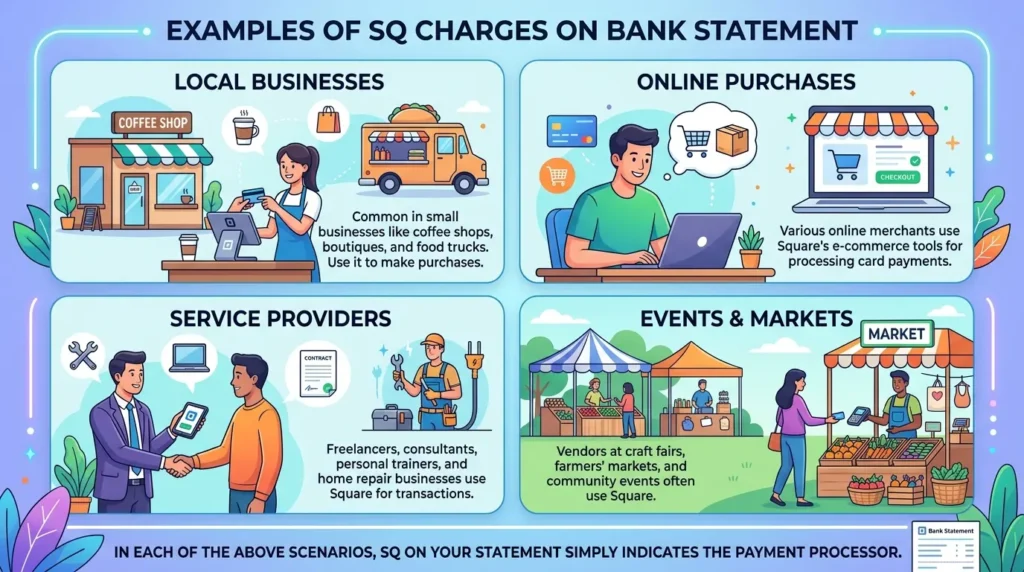
There are numerous instances in which you might find an SQ charge in your transaction history.
· Local Businesses
Square is a popular choice among small businesses because of its low cost and user-friendly setup. Therefore, you can use it to make purchases from local businesses such as coffee shops, boutiques, and food trucks.
· Online Purchases
Various online merchants use Square’s e-commerce tools. Thus, if you have made an online purchase with a merchant, there is a good chance “SQ” will appear on your bank statement.
· Service Providers
Freelancers, consultants, personal trainers, and home repair businesses are examples of service providers that use Square to process credit card transactions.
· Events and Markets
Many vendors at craft fairs, farmers’ markets, and community events are seen using Square to process credit or debit card payments.
In each of the above scenarios, SQ on your statement simply indicates the payment processor. Similar to understanding a PAI ISO charge on bank statement, recognizing SQ transactions can help you identify payment processors that appear instead of merchant names.
How to Identify an SQ Transaction
If you do not remember the sale or receipt linked to an SQ entry on your statement, there are a few ways to identify it.
· Check the Merchant Name
You can usually locate the merchant’s name next to the corresponding SQ on your statement (as it usually displays before the SQ).
For example:
- SQ John’s Bakery
- SQ Green Valley Landscaping
- SQ Fitness Studio
Looking at recent transactions using the merchant identifier can also provide additional clarity.
· Look for Recent Purchases
Try to find items you’ve recently purchased by looking at receipts for the transaction date, either in your email, text message, or confirmation order.
· Check Transaction Amounts
If a transaction matches the amounts you’ve received (in receipts), it will give you an idea of the merchant and, therefore, what this charge is for.
· Ask Family Members
Family members (if you share this card) can also help identify what this charge might represent.
By comparing your notes on these transactions with your purchase history, you will better understand what does SQ means on bank statement.
Is an SQ Charge on Bank Statement Legitimate?
In most cases, yes.
Most SQ charges are legitimate purchases processed through Square.
Since Square is a popular processor worldwide, the appearance of SQ on bank statements is not generally a red flag.
If needed, review each transaction carefully before concluding that no fraudulent activity has occurred with any payment processor.
What If You Do Not Recognize an SQ Charge?
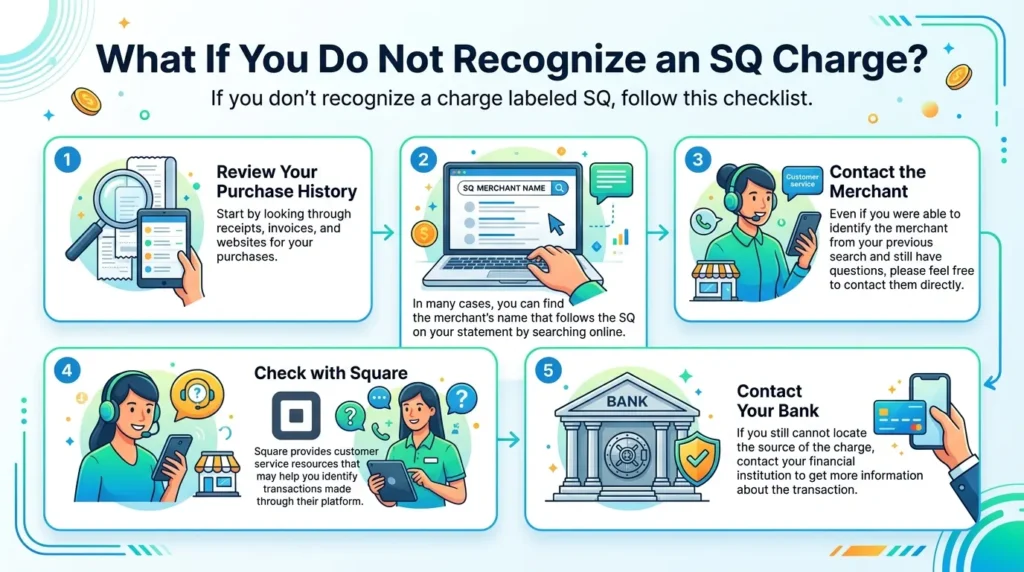
If you don’t recognize a charge labelled SQ, follow this checklist.
· Review Your Purchase History
Start by looking through receipts, invoices, and websites for your purchases.
· Search for the Merchant
In many cases, you can find the merchant’s name that follows the SQ on your statement by searching online.
· Contact the Merchant
Even if you were able to identify the merchant from your previous search and still have questions, please feel free to contact them directly.
· Check with Square
Square provides customer service resources that may help you identify transactions made through their platform.
· Contact Your Bank
If you still cannot locate the source of the charge, contact your financial institution to get more information about the transaction.
Learning about an FDMS charge on bank statement can also help you understand how third-party payment processors appear on financial statements.
Can SQ Charges Be Recurring?
Yes.
Many businesses that use Square offer subscriptions or recurring billing. Some examples include:
- Membership programs
- Fitness subscriptions
- Monthly service plans
- Digital products
- Professional services
In those instances, you may see the same SQ charges posted to your account each month.
If you no longer want these services, contact the merchant directly to cancel your subscription.
How to Prevent Confusion About SQ Charges
Consumers often find it confusing when they see the letter “S” next to their account number on debit and credit card statements, the first time they notice SQ. However, there are a few ways to clarify uncertainty about SQ.
· Save Receipts
Keep all digital or paper receipts for major purchases.
· Monitor Transactions Frequently
Review your bank or credit card statements regularly, so you can see what has been purchased while it’s still fresh in your mind.
· Enable Banking Alerts
Many banks offer their customers alerts whenever an account is accessed, so this provides you with a very accurate way to track your account activity in real time.
· Keep Records of Subscriptions
If you keep a list of your monthly subscriptions, it will help you remember the ongoing charges and more easily identify legitimate SQ charges.
By using the above practices, you will be able to identify what does SQ mean on bank statement and quickly recognize what a legitimate purchase is for you.
Common Misconceptions About SQ
There are several common misconceptions about SQ transactions.
· SQ Does Not Mean Fraud
Just because you do not recognize an abbreviation does not mean it represents fraud. Each year, approximately one-fifth of SQ transactions are legitimate.
· SQ Is Not a Separate Company Charging You
Square handles payments on companies’ behalf. The merchant where you made the purchase is the source of the charge.
· SQ Is Not A Bank Charge
The SQ Code identifies the transaction processor and is not a separate service charge or fee from your bank.
Final Thoughts
If you want to know what does SQ mean on bank statement, the answer is simple: it means Square. Square is a popular payment processor that enables businesses to accept credit card payments.
When SQ appears on a transaction, it indicates that the transaction was done through Square on behalf of a particular business. Most of these transactions are valid; you can usually verify them by checking your purchase receipt, seeing where the merchant is listed, and reviewing your last few purchases.
You can quickly learn to identify SQ transactions by understanding how it works and regularly monitoring your account activity. So, when you see SQ on your bank statement, you’ll know exactly what the charge is and how to verify the transaction’s legitimacy.
FAQs
1. What does SQ mean on a bank statement?
SQ on a bank statement typically means the transaction was processed through Square, a payment processing platform used by businesses to accept card payments.
2. Why does SQ appear before a merchant’s name?
Square often places its identifier before the merchant name on transaction records, so banks may display entries such as SQ Coffee Shop or SQ Local Market.
3. Is an SQ charge on a bank statement legitimate?
In most cases, yes. SQ charges are usually legitimate purchases made through businesses that use Square to process payments.
4. How can I identify an SQ transaction?
You can identify an SQ transaction by reviewing the merchant name listed after SQ, checking receipts, searching recent purchases, or contacting the merchant directly.
5. Can SQ charges be recurring?
Yes. Businesses using Square may offer subscriptions, memberships, or recurring services that can result in regular SQ charges on your bank statement.