
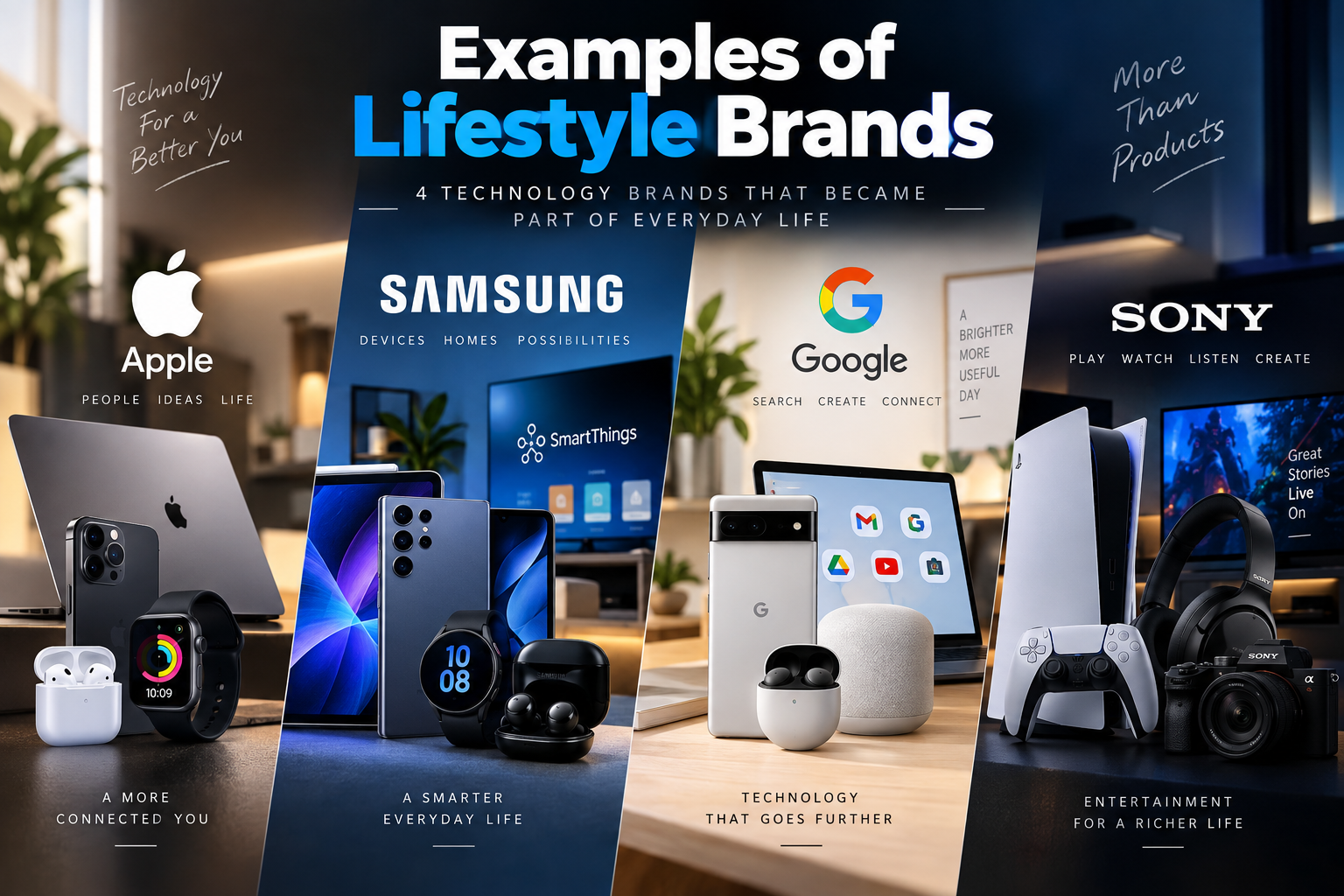

When people search for examples of lifestyle brands, they are often looking for companies that have become more than the products they sell.
Technology provides some of the clearest examples.
Think about how many times you interact with technology during a normal day. You may check your phone after waking up, use a laptop for work, wear a smartwatch, listen through wireless earbuds, watch TV, play games, take photos, or store files online.
This is where technology can become part of a lifestyle.
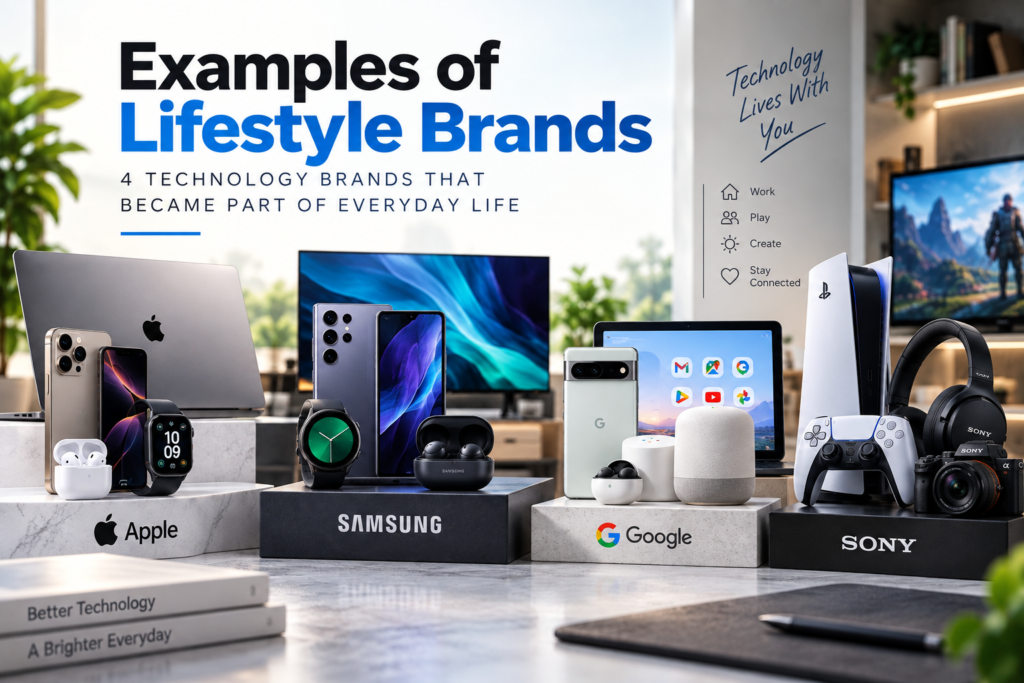
Apple, Samsung, Google, and Sony are four useful examples. Each has built an ecosystem that reaches beyond a single device and becomes part of how people communicate, work, create, relax, and entertain themselves.
What Is a Lifestyle Brand?
A lifestyle brand connects its products with a broader part of the customer’s everyday life.
Instead of being known for only one product, the brand becomes associated with particular activities, interests, habits, or experiences.
For technology companies, that can mean connecting several devices and services around the same user. Four most popular examples of lifestyle brands are as under:
| Brand | Main Lifestyle Connection | Key Products |
|---|---|---|
| Apple | Connected digital life | iPhone, Mac, Apple Watch, AirPods |
| Samsung | Connected devices and home technology | Galaxy phones, watches, TVs, appliances |
| Connected digital services | Pixel, Android, Google apps, smart-home devices | |
| Sony | Entertainment and technology | PlayStation, TVs, cameras, headphones |
These four companies approach lifestyle branding differently, but all extend well beyond a single product.
1. Apple: Technology Built Around Everyday Life
Apple is one of the strongest examples of lifestyle brands in technology because its products are designed to fit into different parts of a person’s day.
The company offers the iPhone, Mac, iPad, Apple Watch, AirPods, Apple TV and various digital services.
Individually, these are technology products.
Together, they create an ecosystem.
One Brand Across Multiple Devices
Consider someone who owns an iPhone.
They might later add AirPods for music and calls, an Apple Watch for notifications and activity tracking, and a Mac for work.
Now Apple is no longer represented by one device.
It may be present when that person works, exercises, communicates, travels, listens to music, takes photographs or watches entertainment.
This is what makes Apple relevant to lifestyle branding.
Its products can become connected parts of a customer’s daily routine.
Apple’s Ecosystem Is the Key
Apple also makes interaction between its products an important part of the experience.
For example, its official Mac information highlights ways Mac and iPhone can work together.
This creates a simple lifestyle-branding cycle:
One device → More connected devices → More daily uses → Stronger ecosystem
Apple therefore demonstrates how a technology company can grow from selling individual devices into providing a wider digital environment.
2. Samsung: Technology Throughout the Home and Day
Samsung is another strong example, but its approach is broader.
Its technology portfolio reaches from smartphones and wearables to televisions, tablets and home appliances.
That allows Samsung to be present not only in a person’s pocket but also throughout the home.
From Smartphone to Smart Home
A customer might use a Samsung Galaxy smartphone and Galaxy Watch during the day.
At home, the same household might have a Samsung television or other connected devices.
Samsung’s SmartThings platform extends this idea by allowing compatible smart devices to be managed within a connected environment.
This gives Samsung a lifestyle connection based on connected living.
Technology becomes part of multiple daily activities rather than remaining limited to a computer or smartphone.
Why Samsung Fits the Lifestyle Brand Model
Samsung demonstrates that technology lifestyle branding can stretch across different spaces.
A smartphone supports communication.
A smartwatch stays with the user throughout the day.
A television provides entertainment.
Connected-home products become part of everyday household routines.
The products are different, but they can exist inside the same broader technology ecosystem.
For Samsung, the lifestyle is therefore not centred on one specific activity. It is centred on using connected technology across everyday life.
3. Google: A Lifestyle Built Around Digital Services
Google provides a different example of technology lifestyle branding.
Many people know Google first through Search, but the company’s products and services now reach into many parts of digital life.
Its ecosystem includes services and products such as:
- Google Search
- Gmail
- Google Maps
- YouTube
- Google Photos
- Google Drive
- Android
- Pixel devices
- Google Home products
This makes Google particularly interesting because its lifestyle presence is not dependent entirely on physical products.
Google Can Follow the User Throughout the Day
Imagine a normal day.
A person checks Gmail in the morning.
They use Google Maps while travelling.
They search for information during work.
Their documents may be stored in Google Drive.
Their photos may be organised through Google Photos.
Later, they watch something on YouTube.
The customer has interacted with the same wider technology ecosystem repeatedly without necessarily thinking about it as a single experience.
That is an important form of lifestyle integration.
Pixel Adds Hardware to the Ecosystem
Google’s Pixel devices extend this connection into hardware.
The Pixel family includes phones, watches, earbuds and tablets, bringing Google’s software and services into physical devices.
This creates a model in which software, services and hardware work around the same digital lifestyle.
Google shows that a lifestyle brand does not necessarily need to be built primarily through fashion, visual identity or physical products.
It can also grow by becoming useful across many everyday activities.
4. Sony: Technology Built Around Entertainment
Sony is another technology company with a strong lifestyle connection, particularly around entertainment and creativity.
Its products extend across categories including:
- PlayStation
- Televisions
- Headphones
- Cameras
- Audio equipment
Unlike Google, which is deeply connected with everyday digital services, Sony’s strongest lifestyle connection is entertainment.
PlayStation Creates More Than a Product Relationship
PlayStation is an important part of Sony’s lifestyle reach.
A PlayStation console is a piece of technology, but gaming itself is a much larger activity.
Players spend time discovering games, playing with friends, competing online, discussing releases and becoming part of gaming communities.
Accessories such as controllers and headsets extend that experience.
The result is not simply:
Buy console → Play game
It can become:
Console → Games → Friends → Online play → Accessories → Community
That is a much stronger lifestyle connection.
Sony Also Reaches Creators and Entertainment Fans
Sony’s cameras give the company another connection with people’s interests.
Photography and video creation can be hobbies, professions or major parts of a creator’s lifestyle.
Headphones and televisions connect the brand with music, films and home entertainment.
Sony therefore occupies several related spaces while remaining focused heavily on technology and entertainment.
This makes it a useful example of how a technology brand can build lifestyle relevance around what people enjoy doing with technology, rather than around the technology alone.
How These Four Technology Lifestyle Brands Differ
Although Apple, Samsung, Google, and Sony operate within technology, their strongest lifestyle connections are not identical.
Apple focuses heavily on a connected ecosystem of personal devices.
Samsung extends connected technology from mobile devices into the home.
Google integrates digital services into everyday online activities.
Sony connects technology strongly with gaming, entertainment and creativity.
This is why all four can work as examples without leaving the technology niche.
They show four different ways technology can become part of everyday life.
Frequently Asked Questions
What are examples of lifestyle brands?
Apple, Samsung, Google, and Sony are examples of lifestyle brands within the technology industry. Their products and services extend across different parts of customers’ daily digital lives.
Is Apple a lifestyle brand?
Apple has strong characteristics of a lifestyle brand because its ecosystem connects products such as iPhone, Mac, Apple Watch and AirPods with communication, productivity, entertainment, fitness and creativity.
Is Samsung a lifestyle brand?
Samsung can be considered a technology lifestyle brand because its ecosystem covers smartphones, wearables, televisions and connected-home technology.
What makes a technology company a lifestyle brand?
A technology company develops lifestyle-brand characteristics when its relationship with customers extends beyond one product. Its devices or services become connected with everyday activities such as work, communication, entertainment, fitness, creativity or home life.
Can gaming be part of a technology lifestyle brand?
Yes. Sony is a good example through PlayStation. Gaming can involve consoles, accessories, online communities, entertainment and social experiences, creating a relationship that extends beyond purchasing a device.
Conclusion
The best examples of lifestyle brands do more than sell individual products. They become connected with activities people perform every day.
Within technology, Apple, Samsung, Google, and Sony demonstrate this in different ways.
Apple builds a connected personal-device ecosystem. Samsung brings technology across mobile devices and the connected home. Google integrates services and devices throughout digital life. Sony connects technology with gaming, entertainment and creativity.
The common point is simple: their technology is not used in isolation. It becomes part of how people live, work, communicate and enjoy their free time.